Saturday, May 18, 2013
2011 Ford Grand C Max Review It Is A Civilized Machine


Friday, May 17, 2013
1957–1959 Ford Fairlane Second Generation
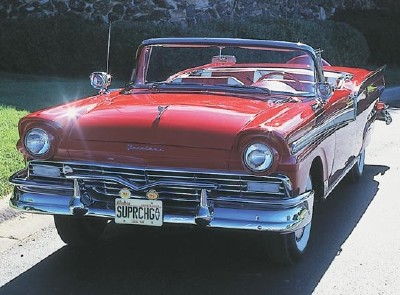 |
| 1957-1959 Ford Fairlane Skyliner-Second Generation |
 |
| 1957-1959 Ford Fairlane Skyliner-Wheel Drive |
 |
| 1957–1959 Ford Fairlane-Front View |
 |
| 1957-1959 Ford Fairlane Skyliner-Engine |
 |
| 1957-1959 Ford Fairlane Skyliner-Open Roof |
 |
| 1957 Ford Fairlane 500 Skyliner |
 |
| 1957 Ford Fairlane 500 Skyliner-Engine |
Ford the story of Ford motors
Ford Motor Company or simply Ford Motors, is an American car manufacturer based in Dearborn, Michigan. This company is currently the second largest car manufacturer in the US and ranks as the fifth largest in the world. Aside from its domestic operations, Ford also operates in the markets of South America, Europe, Asia Pacific, Africa, and the Middle East.
Given its worldwide operations, Ford Motors could be considered as one of the most successful car makers. However, the companys success did not happen overnight. In fact, it took more than 100 years before Ford was able to earn its current status. To provide a clearer picture of the companys development, some of the highlights of Fords history are provided below.
Fords Earliest Foundation
Ford Motor Company was founded by Henry Ford. The company was actually established with the help of Henry Fords acquaintance, Alexander Y. Malcomson, a coal dealer, and Malcomsons uncle, John S. Gray, president of the German-American Bank. To further strengthen the newly established company, Malcomson recruited some of his business partners and urged them to invest. Due to Malcomsons success in recruiting investors, the Ford Motor Company was finally established on June 16, 1903, with 12 investors and 1000 shares. Both Ford and Malcomson owned 255 of these shares, while Gray owned 105. The remaining shares were owned by the other 9 investors.
The first stockholders meeting of the Ford Motor Company happened two days after it was formed. During this meeting, the election of officers happened. Gray became the companys first president, while Ford was elected as vice-president. Under Grays leadership, the company had started to earn profits. Fords total profit in October 1, 1903 was calculated to be around $37,000. This profit further increased to $300,000 in 1905.
But, after a few years of smooth operation, the harmonious relationship among investors was broken. Subsequent clashes between them eventually led to separation and Henry Fords assumption of the presidential position. Under Fords leadership, the company gradually became the largest car maker in the US.
During the first few years, Ford as a car manufacturer, was involved in developing and producing its first car model, which was called the "Model A." The Model A was powered by a two cylinder internal combustion engine, capable of producing 8 horsepower. Ford had sold a total of 1,750 units from 1903 to 1904. The impressive sales record obtained by the Model A marked the first successes of Henry Fords business. However, this model was eventually replaced by the Model C in 1904.
The Ford Model C was actually a refined version of the Model A, with a sportier look and more powerful engine. Ford discontinued the production of the Model C in 1905 with a total of 800 units produced. This model was replaced by the Model F in 1905. In 1906, Ford developed its first six-cylinder powered vehicle and called it the Model K. This was a replacement for the earlier Model B. The Model K was powered by an in-line 6-cylinder engine that produced up to 40 horsepower. Despite its powerful engine, the Model K was considered a failure due to its expensive price and poor quality. Its production had reached its end in 1908. Ford then focused its attention on producing a succeeding model, which was the Model S. However, the demands for the Model S were not so impressive. As a result Ford then introduced the "Model T".
Fords Model T or the T-Model Ford is the companys first affordable vehicle and at the same time one of the most in demand models. Its production started on August 12, 1908, with its first unit leaving the companys assembly line September 27, 1908. The Model T started to establish its iconic image in the automotive market. Since it was affordable and middle-class Americans were capable of buying this car, the demand for the model increased. The 15 millionth unit of the Model T left the companys factory on May 26, 1927. Production of the Model T continued until the end of the same year. After the overwhelming success of the Model T, Ford had produced a lot more models. Some of these were very successful, while several other models failed.
Ford Motors during the First World War
The occurrence of the First World War had greatly affected the automobile production of the Ford Motor Company. Henry Fords pacifist policies were very successful in preventing the companys downfall. In fact, the company became more popular in the First World War when Henry Ford joined other pacifists in Europe to prevent the war from happening. Although their efforts had failed to stop the war, Ford Motors Company became very active in supporting the Allied Powers participation in the war. The companys Model T eventually served as the underpinnings of some of the military vehicles, including the M1918 as well as the 1916 ambulance. Fords participation in the Allied Powers war effort continued until the First World War ended.
Ford Motors after the First World War
Ford Motor Company started to lose its dominance in the automotive market a few years after the First World War, particularly when Edsel Ford was charged with being his fathers successor. The companys gradual decline was caused by its continuous use of the personalized management mechanism, that was starting to become obsolete, as-well as the companys neglect of consumer demands for more improved vehicles.
The companys sales were further worsened by the expansion of some of its closest competitors market share. General Motors and Chrysler were able to grab a significant share of the market from Ford by producing high-quality vehicles and providing credit opportunities to their customers. However, Ford was able to recover from its previous loses by providing similar opportunities to its customers. In addition to this, Fords stoppage of the production of the Model T and the introduction of the redesigned version of the Model A had placed the company back on track.
Fords operation expanded into the luxury market division, when the company acquired the Lincoln Motor Company on February 2, 1922. This was followed by the companys ventures on financing the cultivation of rubber in Brazil in 1928. The rubber cultivated would be used in producing synthetic rubber for use on Ford vehicles. However, this venture failed and only caused the company to spend millions of funds.
The companys operation further expanded in 1938, when the Mercury division was established. This division would handle the mid-priced automotive markets demand for vehicles. Unfortunately, all of these expansion efforts were halted by the "Great Depression."
Ford Motors during the Great Depression
The economic crisis and the collapse of the automotive market in the US, caused by the Great Depression, left some scars on Ford Motor Companys image. In order to stay afloat, the company had to reduce its operation and implement mass lay-offs. As a result, a lot of Ford workers had lost their jobs.
As economic conditions worsened, workers who lost their jobs formed a series of strikes to demand greater support from the company. However, the friction between the protesters, and the police erupted into violence. The police used teargas and water cannons to disperse the crowd, but the protesters responded by throwing rocks. The violence escalated and this forced the police and the companys security to fire live bullets. As the battle ended, 9 individuals were killed and 60 others were seriously injured. Due to this, it took a few more years before Ford Motor Company was able to stabilize its vehicle production.
Ford Motors during the Second World War
Henry Fords pacifist mentality had once again guided his companys fate during the Second World War. To prevent the Nazis from turning the Ford Motor Companys plants in Germany into a nationalized factory, Henry Ford developed a close working relationship with the Nazi government. Fords efforts were effective since the company obtained the 52% ownership of the factories there. Although the Nazi controlled the day-to-day business of these facilities, Ford still remained as the majority owner.
Henry Fords relationship with the German Nazi government remained good for a while. However, this had subsequently changed after the bombing of Pearl Harbor. This event encouraged Ford to provide support for the Allied Forces war efforts, by producing airplane engines. But, this doesnt mean that Fords operation in Europe, particularly in Germany, had stopped. In fact, one-third of the trucks used by the Nazi army were produced by Ford Motor Company. Due to these strategies, Ford was viewed as a company that collaborates with both the Allied and the Nazis and earned a lot of investments from these sources.
Fords direct communications and business ties ended when the US declared war in December 1941. However, there were some allegations that a series of indirect communications between the Nazi government in Germany and Ford still took place. But after an investigation conducted by the US Treasury Department, allegations were dismissed due to lack of concrete proofs.
Ford Motors after the Second World War
After the Second World War, Ford Motors had once again experienced internal chaos. Edsel Ford died in 1943 and left the company under the leadership of Henry Ford. But Henry Fords failing health made it difficult for him to handle the companys business. Due to this, his wife and daughter-in-law intervened and demanded that Henrys grandson "Henry Ford II" should be appointed as the companys new president. They even threatened Henry Ford that they would sell their share of stocks if he refused to give in to their demand.
Although Henry Ford was infuriated by this idea, he had no choice but to give in to the demand and appointed his grandson as the companys president. When Henry Ford II became the president, he was faced with financial chaos with company losing about $9 million a month. This condition and Henry Fords death in 1947 forced the company to hire outsiders to handle its day-to-day business. The hiring eventually weakened the Ford familys grip on the company. Ford Motor Company became a publicly traded company in 1956. During this period the Ford family only maintained a 40% controlling interest in the company. The rise and fall of high-ranking executives hired from outside the company continued up to the present.
Despite the financial and leadership chaos that the company had experienced during these times, Ford Motors was still able to produce some of its most popular vehicles, including the Thunderbird in 1955, the Falcon in 1960, and the Mustang in 1964. In addition to this, the company was also able to establish the Ford Europe in 1967.
Ford Motors in the year 2000 up to the present
High-ranking executives that were hired from outside the company and handle its operations continued to come and go. Harold Polding served as the companys CEO and Chairman from 1990 to 1993. Polding was replaced by Alex Trotman and remained as the companys head until 1998. Jacques Nasser replaced Trotman and served until 2001.William Clay Ford Jr., Henry Fords great-grandson, became the Chairman and CEO of the company from 2001 to 2005. In 2005, Alan R. Mulally from "Boeing" became the companys President and CEO.
In 2006, Ford Motor Company surprised the world when it announced that the company will offer all of its assets for mortgage since they could no longer handle the companys operations. However, the US government provided assistance to the company. After a few years, the company, under the leadership of Alan R. Mulally, was able to pay some of its loans off and continue its production. With Alan R. Mulallys effective leadership, Ford Motor Company is now enjoying significant sales profits and a revival of its financial strength.
Thursday, May 16, 2013
Ford Mustang V6 Sport in Japan

Ford has made a special offer for the Japanese market in the form of a two-door Mustang V6 Sport Appearance. The car produced a limited edition of 25 copies. Buyers can choose from two body colors:..
This Ford Mustang Special Editon V6 Sport Appearance is boosted with a3.7-liter V-6 engine, with an output power of 309HP horsepower and a 378 Nm (278.8 lb-ft) of torque.
Mustang V6 Sport Appearance is available in coupe versions (4.35 million yen = 54 $ 250) and convertible (5.05 million yen = $ 63 000).
which are equipped with a 3.7-liter V6-engine power of 309 hp and 378 Nm of torque.


