Showing posts with label generation. Show all posts
Showing posts with label generation. Show all posts
Tuesday, May 21, 2013
Mitsubishi evolution 10 The tenth generation of the Lancer Evolution
MITSUBISHI EVO X

The Mitsubishi Lancer Evolution, colloquially known as the Lancer Evo or Evo, is a high-performance sedan manufactured by Mitsubishi Motors. There have been ten official versions to date, and the designation of each model is most commonly a roman numeral. All use two litre, turbocharged engines and four-wheel drive systems.
The Evolution was originally intended only for Japanese markets, but demand on the "grey import" market led the Evolution series to be offered through Ralliart dealer networks in the United Kingdom and in various European markets from around 1998. Mitsubishi decided to export the eighth generation Evolution to the United States in 2003 after witnessing the success Subaru had in that market with their Impreza WRX, a direct competitor in other global regions.


Japanese-spec cars were limited by a gentlemens agreement to advertise no more than 280 PS (206 kW; 276 hp), a mark already reached by Evolution IV. Therefore, each subsequent version has unofficially evolved above the advertised power figures, with the Japanese-spec Evolution IX reaching an alleged output of around 321 PS (236 kW; 317 hp). Various versions available in other markets, particularly the UK, have official power outputs up to 411 PS (302 kW; 405 hp).
The tenth generation of the Lancer Evolution was launched in Japan 2007, and overseas markets in 2008.
The original Lancer Evolution was to compete in the World Rally Championship. It used the 2.0 L turbocharged DOHC engine and 4WD drivetrain from the original Galant VR-4 in a Lancer chassis, and was sold in GSR and RS models. The latter was a stripped-down club racing version that lacked power windows and seats, anti-lock brakes, a rear wiper, and had steel wheels to weigh approximately 70 kg (154 lb) less than the 1,238 kg (2,729 lb) GSR, while the former came with all of the conveniences of a typical street car. It came with Mitsubishis 4G63 engine producing 247 PS (182 kW; 244 hp) at 6000 rpm and 309 NВ·m (228 lbВ·ft) at 3000 rpm. 5,000 of the first generation Evolutions were sold between 1992 and 1993. Top speed is 228 km/hour (142 mph)


The Evolution II was upgraded in December 1993, and was produced until 1995. It consisted mainly of handling improvements, including minor wheelbase adjustments, larger swaybars, bodywork tweaks including a larger spoiler, and tires that were 10 mm (0.4 in) wider. This Evolution also has a 50 l (13.2 US gal; 11.0 imp gal) fuel tank. Power output was increased to 256 PS (188 kW; 252 hp) from the same engine and torque was unchanged for both GSR and RS models.

Friday, May 17, 2013
1957–1959 Ford Fairlane Second Generation
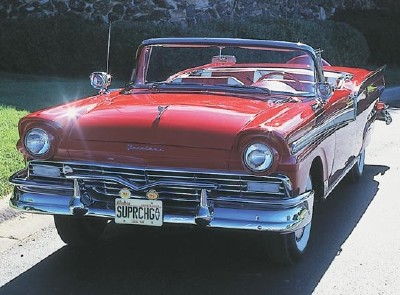 |
| 1957-1959 Ford Fairlane Skyliner-Second Generation |
 |
| 1957-1959 Ford Fairlane Skyliner-Wheel Drive |
Ford-Muscle Car trends was a new look, wider, lower and sleeker with tailfins down In 1957. At that time, for the first time, the bottom line custom level had a wheelbase shorter than the Fairlane. A new top trim level was produced, the Fairlane 500. Engines were largely the same as the previous year. The big news for 1957 was the introduction of the Fairlane 500 Skyliner hardtop retractable power, whose solid top hinged and folded into the trunk space with the touch of a button. The weakness was, he attracted more attention than sales, the option was expensive, unreliable, and took almost all the trunk space when retracted. Even so, it required the roof to be made shorter than the other Fairlanes, and the trunk to be larger.
 |
| 1957–1959 Ford Fairlane-Front View |
 |
| 1957-1959 Ford Fairlane Skyliner-Engine |
Another facelift for 1958 saw fashionable quad headlights, a grid that matched the 1958 Thunderbird, and other lifestyle changes. New big-block V8s FS 332 and 352 CID (5.4) and (5.8 L) V8 replaced the previous larger and better three-speed automatic transmission was also available. 1959 saw a new high-level full-size model introduced in the summer, the Ford Galaxie.
 |
| 1957-1959 Ford Fairlane Skyliner-Open Roof |
 |
| 1957 Ford Fairlane 500 Skyliner |
 |
| 1957 Ford Fairlane 500 Skyliner-Engine |
Than the Fairlane is featured in 1965 James Bond film Thunderball, and also briefly in the James Bond film Die Another Day 2002.
Chevrolet Camaro First Five Generation 2012
 |
| 1967 Chevrolet Camaro SS Black - Front Left View |
Four distinct generations of the Camaro was designed before production ended in 2002. Shingle is transformed into a concept car that was developed form the fifth-generation Camaro, car production started since March 16, 2009.
 |
| 1967 Yenko Camaro Black - Front Right Side View |
 |
| 1969 Chevy Camaro - Front View Picture |
The first-generation Chevrolet Camaro 1967-1969
The Camaro debuted ie from September 1966 for model year 1967 and 1969 on the platform of the new rear-wheel drive GM F-body and will be available as a two-door, 2 +2 seater coupe or convertible with a choice 250 cu in (4, 1 L) inline-6 and 302 cu in (4.9 L) 307 cu in (5.0 L) 327 cu in (5.4 L) 350 cu in ( 5.7 L), or powerplants 396 cu in (6.5 L) V8. Concerned about the great success of the Ford Mustang, Chevrolet executives realized that their compact sporty car, Corvair, would not be able to produce the Mustang in sales volume due to the design of the rear engine, as well as sales declined, partly due to poor advertising book of Ralph Nader, who is not safe at each speed. Therefore, it is presented as the Camaro has the same conventional rear-wheel drive, front-engine configuration as Mustang and Chevy II Nova.
 |
| 1973 Camaro Red LH Frt - Front View |
 |
| Chevrolet Camaro 1967-1969 Photo - The First Generation |
1970-1981 Chevrolet Camaro - Camaro Fifth Generation
Introduced in February 1970, the second generation Camaro model is produced until 1981, with cosmetic changes made in 1974 and 1978 model year. The car was restyled and becomes a little larger and wider with new styles. Still based on the F-body platform, the new Camaro is similar to its predecessor with a unibody, the front subframe, A-arm front suspension and springs to control the solid rear axle. Road & Track Magazine chose SS350 in 1971 as one of the top 10 cars in the world in August 1971. RS, SS and Z28 performance package is gradually disappearing.
 |
| 2011 Camaro Convertible White with Red Stripes - Front Agle View |
 |
| 2012 Chevrolet Camaro ZL1 at Show |
The second generation Camaro
A 1977 Camaro Z28 back into the limelight at the box office hit movie, "Transformers" as Autobot character called "Bumblebee" (Shia LaBeouf) first car of Sam Witwicky. One of the most important heroes of the film, Bumblebee sold on eBay (July 18, 2008) just over $ 40,000 USD, with results going to charity.
 |
| Camaro Transformers At Showroom |
Chevrolet Camaro 1982-1992 Third Generation
The third-generation Camaro produced from 1982 to 1992. This is the first Camaro, which offers a modern fuel injection, Turbo-Hydramatic 700R4 four-speed transmission automatic, a five-speed manual transmission, 16-inch wheels, standard 4-cylinder engine and hatchback bodies. The cars were about 500 pounds (227 kg) lighter than the second-generation model.
The IROC-Z (which means Champions IROC International Race) was introduced in 1985 and continuing until 1990. National Highway Traffic Safety Administration (NHTSA) regulations required CHMSL (center high mounted stop lamp), beginning with model year 1986. For 1986, new brake light is located outside the central area of the back hatch glass. For 1987 and later, the CHMSL is mounted on a glass hatch or integrated into the rear spoiler (if equipped). In 1987, a 5.7 L L98 V8 option in the IROC-Z, combined with an automatic transmission. The "20th Anniversary Commemorative Edition" offered in 1987, and "25th Anniversary Package Heritage" in 1992, which includes 305 cu in (5.0 m) high-performance motor.
 |
| Jegs 2010 Camaro With Beautifull Girl |
Camaro 1993-2002 - Fourth Generation Camaro
In 1993, the fourth generation Camaro debuted the updated F-body platform. Maintains the same characteristics since its introduction in 1967: 2 +2 coupe body styles with seating (with T-top roof option) or convertible (introduced in 1994), the rear wheels, and a choice of V6 and V8 engines. Standard powerplant is a 3.4 liters V6 1993-1995. The more powerful 3.8-liter V6 introduced as an option in 1995 and became standard in 1996. The LT1 V-8 engine, introduced in the Corvette in 1992, is standard on the Z28. Optional equipment includes all-speed traction control and a new six-speed T-56 manual transmission, four-speed automatic transmission is also available.
 |
| 2008 Chevrolet Camaro Silver - Rear View |
 |
| old with New Camaro Challenger and Shelby |
Fifth Generation Camaro from 2010 to present
Based on the 2006 Camaro Concept and 2007 Camaro Convertible Concept, the production of fifth generation Camaro was approved on August 10, 2006. Oshawa Car Assembly produced a new Camaro, which went on sale in the spring of 2009 as 2010 model year vehicles. The fifth generation Camaro was designed by General Motors Holden in Melbourne, Australia, and is based on a highly successful platform of GM Holden Zeta RWD.
 |
| The Snapshot of Old and New Chamaro Generation |
Subscribe to:
Posts (Atom)